When a 3-Year-Old Can't Do Puzzles Yet
Do not rush to compare your child with someone else. Puzzle difficulty changes with experience, picture choice, and piece design. Here is how to restart with four pieces and build one small success at a time.
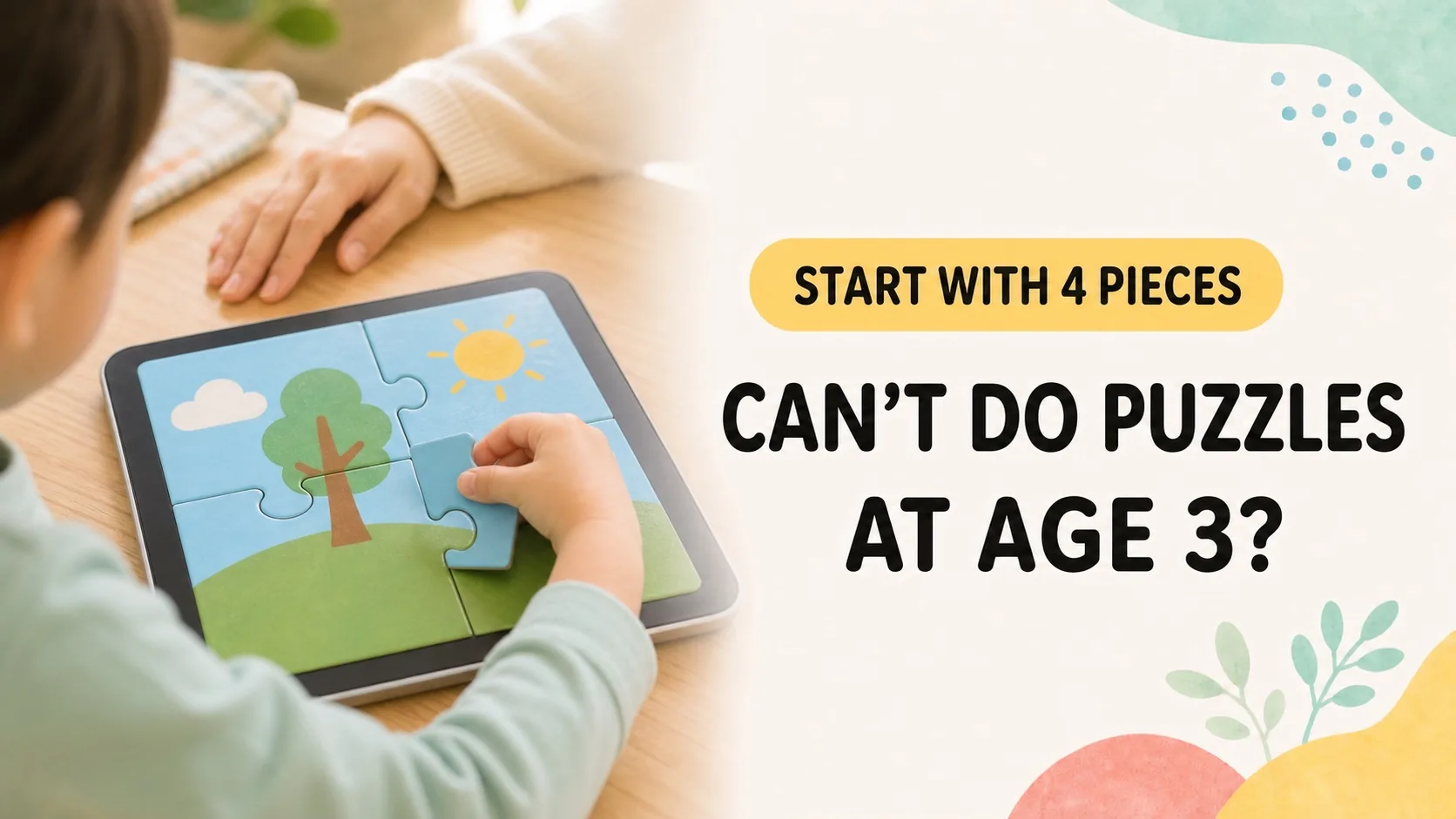
“Other children this age can do many more pieces.” “Mine throws the puzzle.” “Nothing happens unless I finish it.” These moments can make a parent worry that something is wrong.
But the number of pieces is only one part of difficulty. Experience, interest in the picture, piece shape, tiredness, and hunger all matter. Do not diagnose a delay from one activity. Restart with an almost-too-easy four-piece puzzle and build a small success.
In this guide
- Why puzzles may feel hard at age three
- How to identify the exact sticking point
- A five-step practice plan starting with four pieces
- Prompts that protect motivation
- Signs that it is time to try more pieces
This guide offers general ways to adjust play; it is not a developmental assessment. If you notice other ongoing difficulties in daily life or preschool and remain concerned, speak with your child's clinician or a local child-development service.
Research sources and developmental wording were rechecked on August 29, 2026. An observed association in a study is not presented here as a guaranteed benefit or an age-based requirement.
First: not doing a puzzle at age three is not a reason to panic
A University of Chicago study found an association between puzzle play at ages two to four and later performance on a spatial transformation task. It did not establish a required piece count or prove that puzzle play alone causes later ability. The researchers explicitly noted that more work was needed on causality.
Read the study abstract on PubMed and the University of Chicago summary.
The goal is not to pass an age test. It is to match the challenge to a level where your child can try something and experience finishing it.
6 reasons a 3-year-old may not do or enjoy puzzles
1. The piece count does not match current experience
A first-time puzzler and a child who plays every day need different starting points. A paper inset puzzle, a traditional jigsaw, and a touch-screen puzzle also demand different movements.
2. The picture is not interesting
A picture selected for its educational value may not be personally meaningful. Try a photo of the child, family, a pet, trains, dinosaurs, or anything they name immediately.
3. The picture has too few visual clues
Repeated colors, tiny subjects, and busy backgrounds make placement harder. Start with one large subject and clear boundaries between colors.
4. Rotating a piece is not yet an obvious strategy
If a child pushes the same piece into one place, they may not think to rotate it. Instead of turning it for them, ask, “What happens if you turn it around?”
5. The adult completes the hard part too quickly
It is natural to help, but placing the answer removes the moment of testing. Give one clue about color, position, or direction, then wait.
6. The child is tired, hungry, or wants something else
Ability and willingness are different. End the activity on a resistant day and offer another picture later.
A 30-second check: where is the sticking point?
This table is for adjusting play, not assessing development.
| What you see | Possible issue | Change first |
|---|---|---|
| No interest | Picture or timing | Let the child choose a photo |
| Immediately asks you to do it | Too hard or little success | Use four pieces; leave the last one |
| Tries one place repeatedly | Not enough visual clues | Point out one color boundary |
| Pushes with the wrong orientation | Rotation strategy | Ask the child to turn the piece |
| Throws pieces midway | Too many pieces or fatigue | Reduce difficulty and finish quickly |
| Struggles to hold paper pieces | Grip or piece shape | Try a large inset puzzle or touch input |
5 steps for building success from four pieces
- Step 1: Let your child choose one photo
Use a picture of themselves, family, a pet, or another favorite subject. - Step 2: Use a clear photo and only four pieces
Choose one large subject with obvious color boundaries and a simple background. - Step 3: Let the child place the final piece
Complete the first three together so the child experiences making the picture appear. - Step 4: Give one clue about color, place, or direction
Do not place the answer; direct attention to one useful feature. - Step 5: Repeat the same photo, then try nine pieces
Increase difficulty when the child finishes with little help and wants to play again.
Four pieces are not an age standard. They are a restart point that makes completion likely. During the first attempt, place three pieces together and let your child make the picture appear with the last one. Next time, leave two.
Use clues such as “Is the face near the top?” “Where could the blue parts connect?” or “What if you turn that piece?” Once the child finishes with little help, asks to repeat, and tries another orientation after a miss, move from four to nine pieces. Return to four whenever needed.
PhotoPuzzle turns one selected photo into 4, 9, 16, 25, or 36 pieces. You do not need to buy another puzzle just to adjust the level.

Prompts that protect motivation
The Harvard Center on the Developing Child recommends making challenges achievable and praising effort and process rather than only ability or outcomes. See its science-based guide to motivation.
| Avoid | Try instead | Purpose |
|---|---|---|
| “No, not there.” | “Where could this color connect?” | Look for a clue |
| “See? It is easy.” | “You tried turning it.” | Notice the process |
| “You are three; you can do this.” | “Let's try four pieces today.” | Remove age comparison |
| “You're a genius!” only | “You kept trying different ways.” | Recognize effort |
| “Finish quickly.” | “Which piece do you want to try?” | Return agency |
Avoid finishing every hard piece, comparing siblings, increasing difficulty after frustration, or forcing practice on a resistant day. Protecting “I want to try again” matters more than a daily schedule.
Paper puzzle or app: which is better for a stuck 3-year-old?
They provide different strengths rather than a simple winner. Paper gives real grasping and fitting; an app makes picture and difficulty changes immediate.
| Feature | Paper puzzle | Puzzle app |
|---|---|---|
| Hand experience | Grasp a physical object | Easy touch movement |
| Lost pieces | Possible | None |
| Difficulty | Often requires another puzzle | Changes instantly |
| Picture | Fixed | Any chosen photo |
| Travel | Must be carried | Device only |
For example, use a touch puzzle to learn where pieces belong, then a large inset puzzle another day to practice grasping and fitting.
When to move to 9, 16, 25, and 36 pieces
| Level | What to look for | Parent support |
|---|---|---|
| 4 | Places the final piece | Celebrate finishing together |
| 9 | Uses the completed picture | One color or position clue |
| 16 | Tries rotating independently | Do not answer immediately |
| 25 | Groups by color or picture area | Help organize only when stuck |
| 36 | Uses a personal strategy | Observe rather than direct |
These are observable signs, not age requirements. Returning to an easier level is adjustment, not regression. For broader age guidance and more apps, see the 12 best jigsaw puzzle apps for kids.
If your child simply does not like puzzles
Shape sorters, blocks, building toys, origami, matching games, and finding shapes around the room all provide other ways to explore space. Puzzles are not the only route to spatial learning. Offer them again when a new favorite picture or theme appears.
When concern continues, describe situations rather than a piece count
One puzzle activity cannot establish a developmental delay. If persistent difficulties also appear in dressing, eating, language, hand use, or preschool routines, you can discuss them with your child's clinician or local child-development service.
It may help to note two or three examples: which puzzle or object was used, what your child did independently, where they became stuck, and what kind of help changed the result. Those observations are more useful than “cannot do X pieces.”
Frequently asked questions
How many puzzle pieces should a 3-year-old be able to do?
There is no single normal number. Experience, puzzle type, picture complexity, and piece size all change the task. A child who is stuck can start with four pieces.
Are four pieces too easy for a 3-year-old?
The goal is not to prove an age level. It is to learn the sequence and enjoy finishing. If four pieces are easy, move to nine immediately.
How long should we practice every day?
You do not need a time target. Stop while the child could still want to play again. Take a break on resistant days and offer a different picture another time.
Does repeating the same puzzle still help?
Yes. Remembering the sequence is part of gaining confidence. Once the child is comfortable, keep the same picture and increase the piece count.
What should I do if my child throws the puzzle or gets angry?
End the activity for now. Check tiredness, hunger, picture interest, and difficulty. Do not force another attempt; restart with an easier version next time.
Can I mention puzzle difficulty during a developmental appointment?
Yes, but one puzzle task cannot establish a developmental delay. If you also notice persistent difficulties in daily routines or preschool, describe the specific situations and what your child can do independently to their clinician or local child-development service.
Conclusion: “can't yet” is a cue to adjust the challenge
Before comparing ages, check piece count, picture interest, visual clues, rotation, adult help, and the child's current state. Start with four pieces, a favorite photo, and the final piece. Give one clue rather than the answer, and describe the trying rather than only the result.
PhotoPuzzle lets the child keep the same meaningful photo while moving through 4, 9, 16, 25, and 36 pieces — and return to four at any time.
PhotoPuzzle
Use a photo your child chose, then switch between 4, 9, 16, 25, and 36 pieces. Free, no ads, no in-app purchases. The iPhone and iPad app is available now; Android is coming soon.